Breaking · Post Line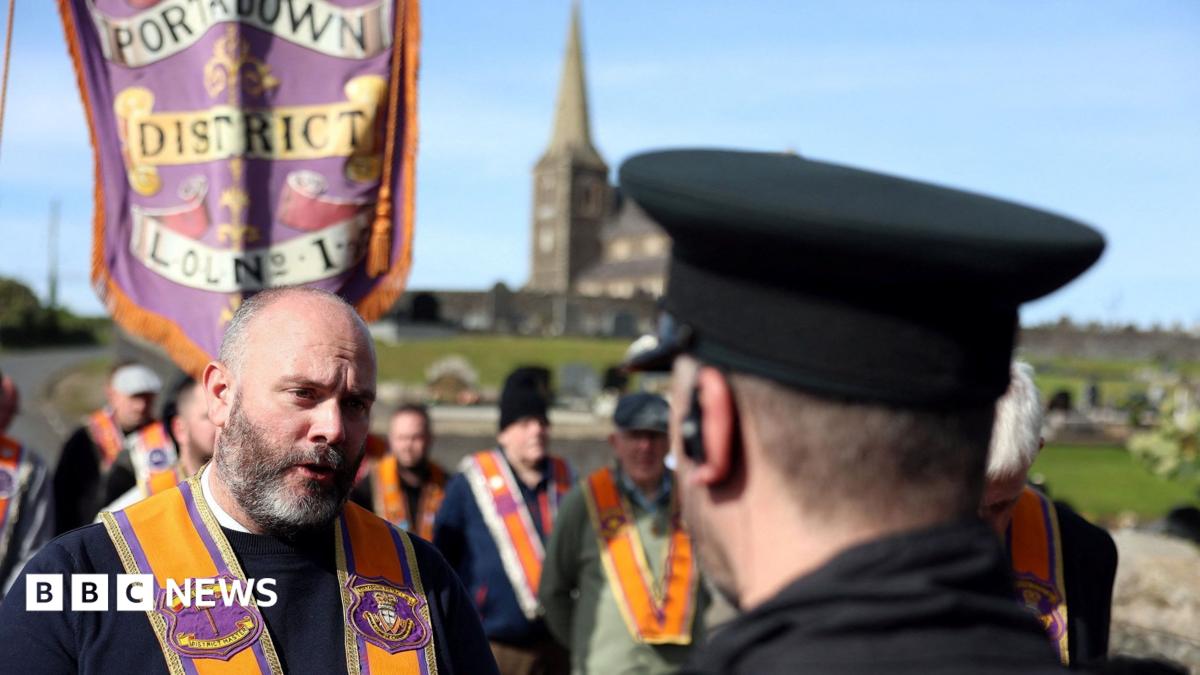
Image source, Reuters Image caption, Portadown Deputy District Master Alastair Power speak to a police officer on Monday By Catherine Morrison and Amy Stewart BBC News NI Protesters remained on the Garvaghy Road overnight as the Drumcree parade dispute continues. The main parties involved in the dispute in Northern Ireland are still in a stalemate, following a day of political talks and heated exchanges at Stormont. Talks to resolve the issue took place on Monday as members of the Orange Order waited to begin their permitted parade, which was due to take place on Sunday morning, and walk down the mainly-nationalist Garvaghy Road in Portadown.
Orangemen also maintained a presence at Drumcree church overnight on Monday, but were smaller in number than previous nights. They spoke to officers at the police line near the church in an attempt to march down the Garvaghy Road. However, there did not appear to be any serious expectation that would happen.
Protesters had blocked the road over the weekend, and after a meeting with the Northern Ireland secretary, a representative of the road's residents said the Orange Order should focus on a different route. Image caption, Protesters, pictured on Monday afternoon, continued to maintain a presence on the Garvaghy Road Christopher Nelson, who was 11 when his mother, the solicitor Rosemary Nelson , was murdered by loyalists in 1999, said the current situation had brought back memories of that time. Rosemary Nelson represented several high-profile clients including prominent republican Colin Duffy and the Garvaghy Road Residents Association.
Nelson said he "dreaded the summer holidays approaching" because he knew his mother "would be spending a lot of time on the Garvaghy Road". "With that came the worry about what was going to happen her when she was out there. Is mum coming home and if she is she going to be okay?" He said his mother spoke to her children about her job a lot and told them she was "helping families like our own".
"She tried her best to make you feel safe even though there was uncertainty in the back of your head," he told BBC Radio Ulster's Good Morning Ulster programme. Nelson is very proud of his mother and has never spoken publicly about her death. He feels now is the time to do so because "if she were here she would want me to be here and she would be standing on that road".
Image source, Handout Image caption, Chris Nelson urged politicians to "think about the children on both sides" Now a father-of-two himself, and married to Sinn Féin councillor Catherine Nelson, he said he did not want any child "worrying or concerned" and said it was like it was "happening all over again". He said his message to representatives was to "think about the children on both sides". "This comes from a child who went through it, who experienced it, whose life it impacted.
Do whatever needs to be done to protect them," he said. He added that he was "very worried" about the current situation as "I know how badly it escalated and what the repercussions were in many cases". Image caption, Lurgan solicitor Rosemary Nelson was murdered in 1999 The Drumcree parade, which in the 1990s sparked some of the most serious disorder in Northern Ireland's history, was due to go ahead for the first time in 30 years after a series of legal challenges.
Since 1998, the Orange Order had been banned from completing its Drumcree march - and until this year had been repeatedly refused permission to finish the route by the Parades Commission, which was set up to adjudicate disputes. The Orange Order is a Protestant pro-British organisation, while the area where it wants to walk - specifically along the Garvaghy Road - is largely Catholic and predominantly inhabited by pro-Irish nationalists. On Sunday, protesters on the Garvaghy Road were joined by members of Sinn Féin, including First Minister Michelle O'Neill, and the Social Democratic Labour Party.
The Democratic Unionist Party subsequently accused O'Neill of acting unlawfully. Northern Ireland Secretary Sir Chris Bryant said "nobody should be attending an unlawful protest", but he added it was not his job "to decide whether somebody has or hasn't broken the law". Speaking in the Northern Ireland Assembly on Monday, O'Neill said she was proud to protest with the residents.
What happened on Monday? People continued to gather at the Garvaghy Road, with a crowd of up to 400 people at one point on Monday night - and a group of Orangemen tried to begin their parade a number of times. On Monday night, police scaled back their operation with only two police cars and one Land Rover in place.
The road was not blocked. The two most senior members of Portadown Orange Order met Sir Chris at Hillsborough Castle. They described the hour-long talks as "constructive".
Breandán Mac Cionnaith, from the Garvaghy Road Residents Coalition, also met the secretary of state. He said the Orange Order should use their outward route to Drumcree Church as their return route, rather than the Garvaghy Road. How did we get here?
The Orange Order, the most prominent of the loyal orders associated with Protestants in Northern Ireland, holds thousands of parades every year and the vast majority pass off without incident. However, many Catholics see the marches as sectarian and object to them passing through, or close to, Catholic or nationalist areas. The Garvaghy Road had been part of the Drumcree route, but by the mid 1990s nationalist residents protested against the parade.
The row sparked some of the most serious public disorder in Northern Ireland's history and was linked to several murders. The row reemerged after a court case in which a ruling by the Parades Commission - the organisation formed during the Drumcree dispute to decide on contentious marches during Northern Ireland's parading season - was overturned. On Friday, following 28 years of unsuccessful applications, the commission decided the march could go ahead with restrictions in place.
Rather than start at 13:00 on Sunday as intended, the commission said it could begin no later than 08:00 and with 35 participants rather than the 60 the Orange Order requested. However that decision was challenged in several Belfast courts on Saturday, before finally being given the go ahead just hours before it was due to take place . Image source, PA Media Image caption, Protesters spent more than a day along the Garvaghy Road, with the road blocked at a number of points The Drumcree dispute was one of Northern Ireland's most serious parading disputes during the 1990s, when stand-offs over attempts by the Orange Order to march along the Garvaghy Road were accompanied by riots, roadblocks and killings.
When the Orange Order was prevented by police from walking down the route in July 1995, there was a tense stand-off. It was the same for the next three years. Violence related to the dispute resulted in riots, roadblocks and murders across Northern Ireland.
In 1998, the newly-established Parades Commission ruled that the Orange Order should not march down the road - a decision upheld until Friday.
Source: BBC